


Generative Engine Optimization (GEO): The Next Evolution of SEO
Last Updated: 6 months ago

Summary: Generative Engine Optimization (GEO) is reshaping how businesses achieve visibility online. This article explains what GEO is, how it differs from traditional SEO, and why organizations must adapt to remain competitive in AI-driven search environments. It outlines practical strategies, tools, and priorities to help businesses improve their chances of being cited in AI-generated answers and future-proof their digital presence.
What Is Generative Engine Optimization (GEO)?
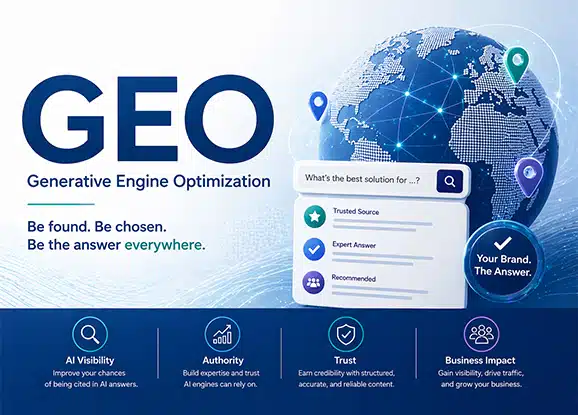
Generative Engine Optimization (GEO) is the practice of optimizing content so it can be selected, summarized, and cited by AI-powered search systems such as Google AI Overviews, ChatGPT, and other generative engines.
Unlike traditional SEO, which focuses on improving rankings in search engine results pages, GEO focuses on inclusion within AI-generated answers. This represents a fundamental shift in how users discover and consume information.
To succeed with GEO, content must be structured, authoritative, and clearly written so AI systems can easily extract and trust it. This includes direct answers, logical formatting, and strong credibility signals.
AI Overviews now appear in roughly 13% of Google searches, up from about 6.5% in early 2025, more than doubling in just a few months.
AI search is not a future consideration, it is the current answer surface for high-intent queries. Brands not optimized for generative results are missing the most valuable audience. Source: Semrush / Datos AI Overviews Study, 2025; industry AI search analyses
Applying GEO techniques improves citation rates in AI-generated responses by up to 40%.
Generative engines evaluate and cite sources based on authority, clarity, and structure, not just rankings. Source: “Generative Engine Optimization” – Aggarwal et al., Princeton / Georgia Tech / Allen Institute for AI, 2024
GEO vs Traditional SEO: What’s Changed?
Traditional SEO and GEO share the same foundation, but they serve different visibility goals.
Traditional SEO focuses on rankings, keywords, and backlinks. GEO focuses on whether your content is selected and cited within AI-generated responses. This introduces a new layer of competition that exists above traditional search results.
AI engines prioritize clarity, structure, and authority over position alone. As a result, content that ranks first is not guaranteed to be cited, while lower-ranking content can still be featured if it better meets AI extraction criteria.
This shift introduces what can be described as the “citation layer,” where visibility depends on being included in the answer itself rather than simply appearing in search results.
60% of sources cited in AI-generated answers do not rank in the traditional top 10 for the same query.
AI engines evaluate authority, structure, and answer quality differently than Google’s ranking algorithm. Source: Profound / Gumshoe AI search visibility research and independent reviews, 2025
How does your content score for AI citation potential?
Our SEO audit now includes an AI visibility assessment, identifying which pages have the structure, authority, and answer signals needed to be surfaced in AI Overviews and chat-based search responses.
How AI Chooses What to Cite
AI models extract and prioritize content that is:
- Clearly structured with headings, lists, and schema
- Directly answering user questions
- Demonstrating expertise and authority
- Written in natural, easy-to-understand language
Why Rankings Alone Are No Longer Enough
Ranking is now just one signal among many. AI-generated answers often reduce the need for users to click through to websites, meaning visibility increasingly depends on being included in the answer itself.
How Generative Engine Optimization Works
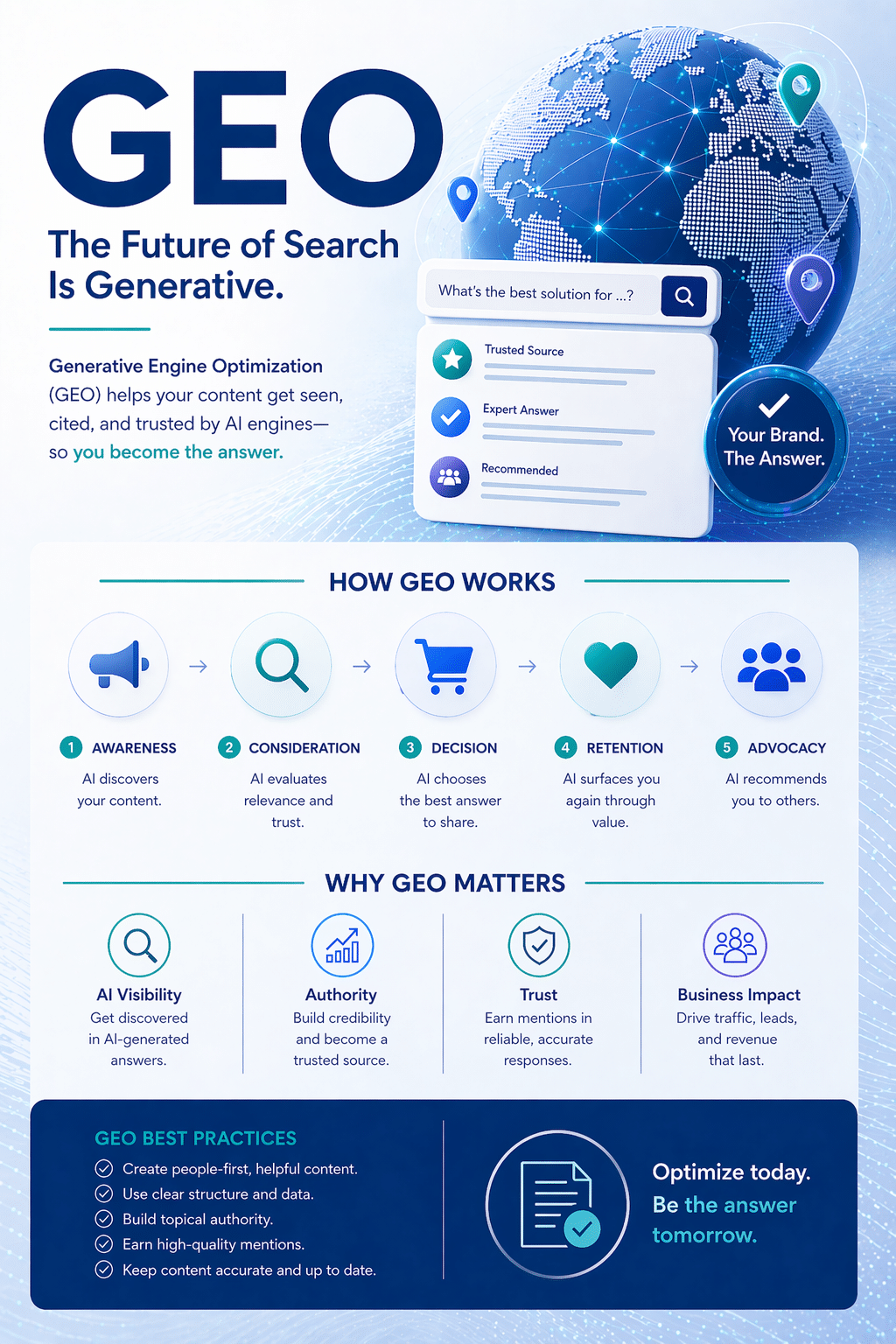
GEO operates across three core layers that work together to improve AI visibility.
Content Structure
Content must be easy to scan and understand. This includes clear headings, concise answers, and logical formatting such as lists and FAQs.
Authority Signals
AI engines favour content that demonstrates expertise. This includes well-developed topics, credible sources, and consistent publishing within a niche.
Technical Optimization
Technical elements such as schema markup, entity clarity, and clean site architecture help AI systems interpret and trust your content.
GEO is not just a content strategy. It is a coordinated approach that combines structure, authority, and technical execution to improve how content is selected and cited.
Generative Engine Optimization Tools & Tactics
Businesses implementing GEO should focus on tools and tactics that improve visibility within AI systems.
Key tools and approaches include:
- AI visibility tracking platforms
- Structured data and schema generators
- Content optimization tools
- Entity and semantic SEO solutions
Effective tactics include:
- Creating direct-answer content blocks
- Optimizing for question-based queries
- Improving readability and clarity
- Building topical authority through content clusters
These approaches help ensure content is both discoverable and usable by AI engines.
GEO Services: What to Prioritize First
For organizations looking to implement GEO, the most effective starting point is a comprehensive audit.
A GEO audit identifies gaps in:
- Content structure
- Authority signals
- Technical readiness
From there, businesses should prioritize:
- High-intent pages that influence conversions
- FAQ and answer-driven content
- Schema implementation
- Authority-building content initiatives
Only 9% of businesses have a documented strategy for generative AI search, despite 58.5% already seeing AI Overview impressions.
Early adopters of GEO will gain a compounding advantage before the channel becomes saturated. Source: Conductor AI Search Readiness Survey, 2025; BrightEdge AI Search Research, 2024
Is your content being cited in AI-generated answers?
Find out where your brand stands in generative search. Book a free 30-minute consultation and walk away with a clear GEO action plan, what to optimize, what to create, and what to stop spending time on.
The Future of Search: Why GEO Matters Now
Search is rapidly evolving from a list of links to a system of direct answers. AI is becoming the primary interface for information discovery, changing how users interact with search engines.
GEO is the foundation for maintaining and growing visibility in this new environment. Businesses that adapt early will be better positioned to capture high-intent audiences and sustain long-term growth.
Organizations that invest in GEO today are building a competitive advantage that will continue to grow as AI-driven search expands.
Websites with structured data markup are significantly more likely to be featured in AI Overviews.
Schema, entity clarity, and content architecture directly influence AI extraction and trust. Source: Search Engine Land; Google Search Central Documentation, 2025
Want to know how AI-ready your website actually is?
A free website audit reveals exactly how your content structure, technical setup, and authority signals either support or limit generative engine visibility. Start with the audit, then build a clear path forward.
FAQs
What is generative engine optimization (GEO)?
Generative Engine Optimization is the process of optimizing your content so it can be selected, summarized, and cited by AI-driven search engines and chat-based platforms.
Is GEO replacing traditional SEO?
No. GEO builds on SEO. Traditional SEO helps your content rank, while GEO ensures it is included in AI-generated answers. Both are now essential for digital visibility.
How long does it take to see results from GEO?
Results can begin appearing within weeks for optimized content, particularly in AI Overviews. However, consistent authority and citation growth require ongoing effort.
Do I need a GEO strategy now?
Yes. AI-driven search is already influencing how buyers find and evaluate businesses. Early adoption provides a measurable competitive advantage.

Don't stop the learning now!
Here are some other blog posts you may be interested in.
VIEW ALL BLOG POSTS-
Generative Engine Optimization (GEO): The Next Evolution of SEO
Generative Engine Optimization (GEO) is the practice of optimizing content so it can be selected, summarized, and cited by AI-powered search systems …
READ MORE -
Customer Journey Mapping: How to Understand, Design, and Optimize Every Stage of the Buyer Journey
Customer journey mapping is the process of visualizing how a customer interacts …
READ MORE -
Answer Engine Optimization (AEO): What It Is, Why It Matters, and How to Win AI Search
Answer Engine Optimization (AEO) is the process of creating and structuring content so AI-powered search engines can easily …
READ MORE