


Customer Journey Mapping: How to Understand, Design, and Optimize Every Stage of the Buyer Journey
Last Updated: 6 months ago

Summary: Customer journey mapping helps businesses understand how prospects move from initial awareness to long-term loyalty. This guide breaks down each stage, explains why it matters, and shows how to build and optimize a journey map that improves conversions, customer experience, and revenue growth.
What Is Customer Journey Mapping?
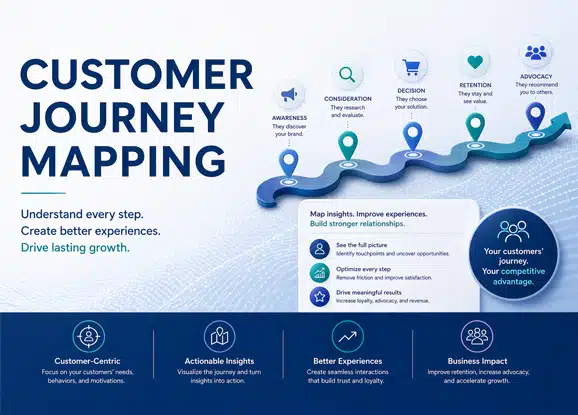
Customer journey mapping is the process of visualizing how a customer interacts with your business across every stage, from initial awareness to long-term advocacy.
It captures every touchpoint a prospect encounters, including search engines, website visits, emails, sales conversations, and post-purchase interactions. The purpose is to uncover friction points, identify missed opportunities, and improve the overall customer experience.
This approach applies to both B2B and B2C organizations, though B2B journeys are often more complex due to multiple decision-makers and longer sales cycles. Regardless of industry, a well-structured journey map aligns marketing, sales, and customer experience into a unified strategy.
Companies that excel at customer journey mapping see a 37.4% increase in customer satisfaction and 35.4% increase in annual revenue
Mapping the customer journey is not just a visualization exercise. It is a strategic framework that helps businesses replace assumptions with data-driven insights, leading to better decisions and stronger results. Source: Aberdeen Group, “Customer Journey Mapping: Lead the Way to Advocacy
Why Customer Journey Mapping Matters More Than Ever
Modern buyers no longer follow a straight path to purchase. Instead, they interact with multiple channels before making a decision.
Without a clear understanding of this journey, businesses miss critical opportunities to influence prospects at key moments. Journey mapping provides visibility into where potential customers drop off, hesitate, or choose competitors.
It also aligns internal teams around real customer behaviour rather than internal assumptions. This alignment improves efficiency and maximizes return on investment across marketing, sales, and retention efforts.
A prospect might discover your brand through search, validate it through reviews, compare options across competitors, and convert through a direct visit or consultation. Missing even one of these touchpoints can result in lost opportunities.
Today’s buyers interact with ~6 touchpoints before making a purchase
The path to purchase is not linear. Search, social, email, review sites, and AI-generated answers all play a role – and missing any single touchpoint creates a gap competitors can fill. Source: Harvard Business Review / Google–Ipsos Multi-Touchpoint Research
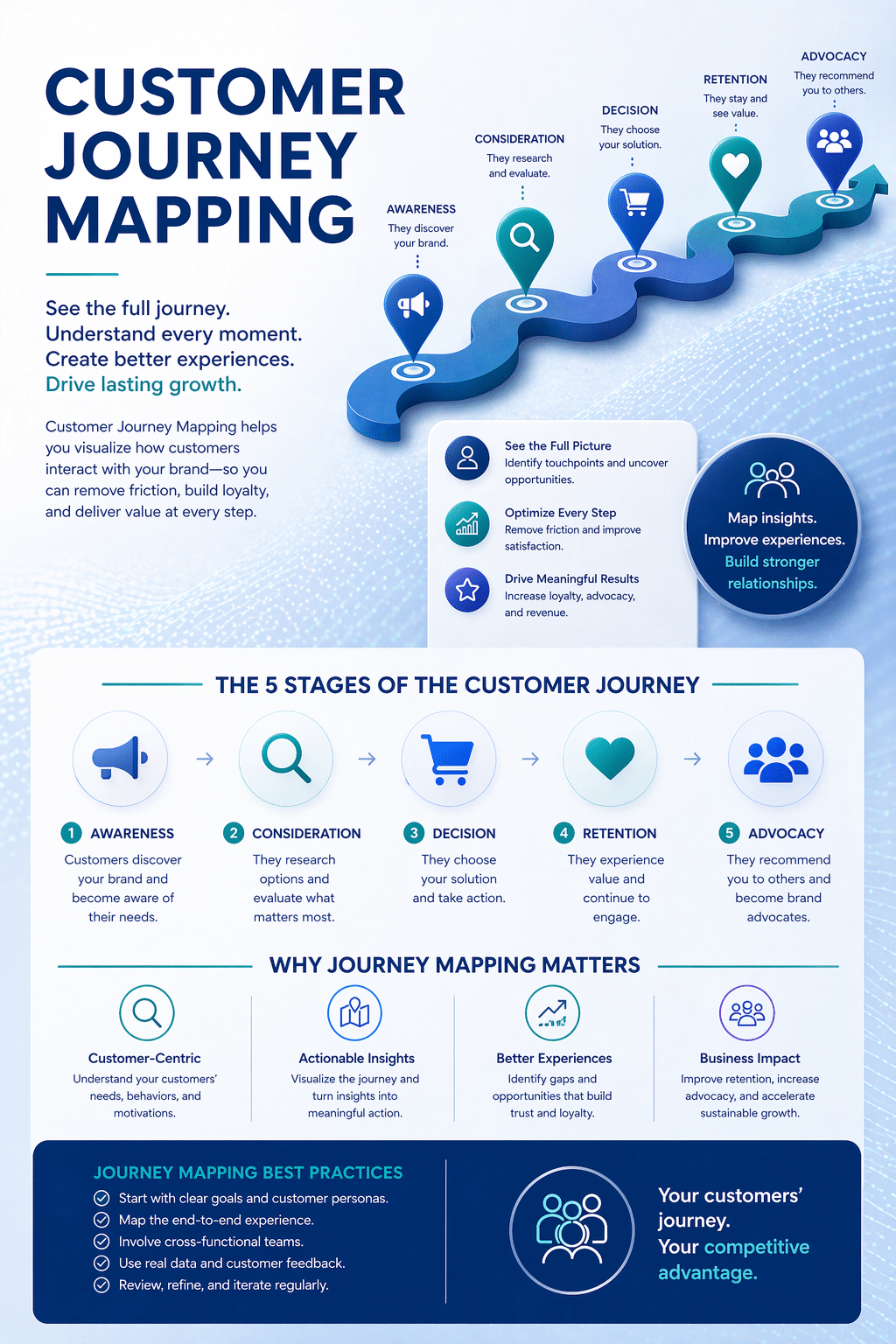
Stages of the Customer Journey (With Real-World Context)
Understanding each stage of the customer journey allows businesses to deliver the right message at the right time.
Awareness Stage
At this stage, customers recognize a problem or need and begin researching solutions. They typically engage with search engines, social media, and referrals.
Content such as blogs, guides, and educational resources plays a key role in capturing attention and building initial trust.
If your business is not visible during this phase, the journey may never begin.
49% of consumers use Google to discover new products or brands they were not previously aware of
Search is not just a consideration tool – it is the primary awareness channel for intent-ready buyers. Your organic visibility at the awareness stage determines whether customers enter your journey at all. Source: Think with Google Retail Touchpoints Study, 2023
Consideration Stage
Customers evaluate potential solutions and compare providers. They look for proof of credibility through case studies, testimonials, and detailed service pages.
Trust, differentiation, and clarity become critical factors in moving forward.
Decision Stage
At this point, customers narrow their options and engage directly with businesses. Consultations, proposals, and demonstrations play a key role.
Any friction, confusion, or lack of clarity can lead to lost deals.
Delivery & Experience
Once a decision is made, the customer evaluates whether expectations are met. Communication, onboarding, and execution determine satisfaction.
This stage has a direct impact on retention and long-term value.
Loyalty & Advocacy
Satisfied customers become repeat buyers, provide referrals, and leave reviews. Retention and expansion often become the most efficient growth drivers.
As illustrated in the customer journey framework , customers move through structured stages with clear emotional shifts, from uncertainty in early research to confidence and advocacy after successful delivery.
How to Build a Customer Journey Map (Step-by-Step)
Creating a customer journey map requires both strategic thinking and data-driven insight.
Step 1: Define your customer personas and goals
Understand who your customers are, what they need, and what success looks like for them.
Step 2: Identify all touchpoints across channels
Map every interaction, including search, website visits, emails, sales calls, and post-sale communication.
Step 3: Map actions, emotions, and pain points
Document what customers are doing, how they feel, and where they encounter challenges.
Step 4: Identify friction and drop-off points
Pinpoint where prospects disengage or fail to convert.
Step 5: Align content and marketing to each stage
Ensure your messaging supports the customer’s needs at every phase of the journey.
Step 6: Continuously measure and optimize
A journey map is not static. It must evolve based on performance data and customer behaviour.
A strong journey map should include:
- Customer actions
- Pain points
- Motivations
- Channels
- Content types
Ready to see how your customers actually find you and where you lose them?
We map the full digital journey and identify where organic search, AI visibility, and content are capturing or losing prospects at every stage.
Customer Journey Mapping Examples
Practical examples help bring journey mapping to life.
Example 1: Local Service Business
- Entry point: Google search
- Touchpoints: Blog content → service page → contact form
- Conversion: Consultation booking
- Risk: Poor website experience or unclear value proposition
Example 2: B2B Company
- Entry point: Educational content
- Touchpoints: Blog → downloadable guide → email nurturing → sales call
- Conversion: Proposal acceptance
- Risk: Weak follow-up or lack of trust signals
Example 3: E-commerce Brand
- Entry point: Social media or search
- Touchpoints: Product pages → reviews → cart → checkout
- Conversion: Purchase
- Risk: Abandoned cart or unclear pricing
Each journey highlights how multiple interactions influence decisions and where optimization can improve outcomes.
Customer Journey Mapping Tools & Software
There are several tools available to help visualize and organize customer journey data, including:
- Miro
- Lucidchart
- HubSpot
- Smaply
These tools can support mapping efforts, but they do not replace strategy. Many businesses fail because they create journey maps but do not act on the insights.
Want to know how your brand appears during your customer’s research phase?
Our SEO analysis shows you exactly where you show up and where competitors are intercepting your prospects before they reach you.
Why Customer Journey Mapping Is Difficult (And Where Businesses Fail)
Despite its value, many businesses struggle with customer journey mapping.
Common challenges include:
- Relying on assumptions instead of real data
- Siloed teams with limited collaboration
- Lack of visibility across multiple channels
- Failure to update the journey over time
- Overcomplicating the process without execution
As buying processes become more complex, the need for accurate, actionable journey mapping becomes even more critical.
77% of B2B buyers say their last purchase was very complex or difficult – primarily because of the number of stakeholders and information sources involved
In B2B, customer journey mapping is not optional – it is essential. The longer and more complex the buying cycle, the greater the cost of not understanding where prospects stall, disengage, or switch to a competitor. Source: Gartner B2B Buying Report, 2024
Not sure where your website fits in your customer’s journey?
A free website audit shows you how your site performs across awareness, consideration, and conversion stages and where you’re losing opportunities.
FAQs
What is customer journey mapping in simple terms?
Customer journey mapping is the process of visualizing how a customer interacts with your business across every stage, helping you identify opportunities to improve experience and conversions.
Do I need software to create a customer journey map?
No. While tools can help visualize the journey, the most important factor is understanding your customer behaviour, touchpoints, and gaps.
How long does it take to build a customer journey map?
It depends on complexity, but most businesses can create a foundational map within a few weeks and refine it over time.

Don't stop the learning now!
Here are some other blog posts you may be interested in.
VIEW ALL BLOG POSTS-
Generative Engine Optimization (GEO): The Next Evolution of SEO
Generative Engine Optimization (GEO) is the practice of optimizing content so it can be selected, summarized, and cited by AI-powered search systems …
READ MORE -
Customer Journey Mapping: How to Understand, Design, and Optimize Every Stage of the Buyer Journey
Customer journey mapping is the process of visualizing how a customer interacts …
READ MORE -
Answer Engine Optimization (AEO): What It Is, Why It Matters, and How to Win AI Search
Answer Engine Optimization (AEO) is the process of creating and structuring content so AI-powered search engines can easily …
READ MORE