

Zero-Click Search in 2026: What It Is, Why It Matters, and How to Adapt
Last Updated: 6 months ago

Summary: Zero-click search is changing how people interact with search results and how SEO success should be measured. As search engines increasingly deliver answers directly on the results page through featured snippets, knowledge panels, and AI-powered summaries, fewer users are clicking through to websites. This article explains what zero-click search is, why it is growing, how it affects organic traffic, and what SEO professionals can do to adapt. The goal is not to resist zero-click search, but to use it strategically to improve visibility, credibility, and long-term performance.
What Is Zero-Click Search?
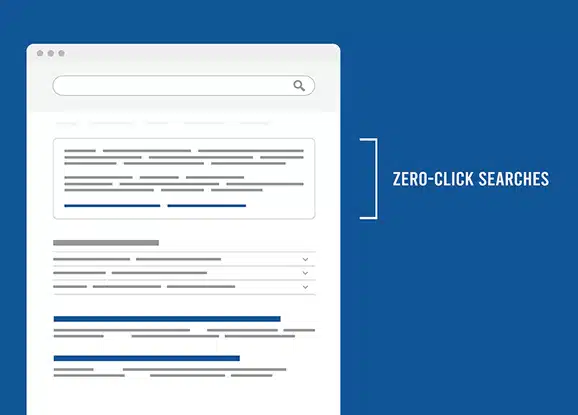
Zero-click search refers to a search experience where the user gets the answer they need directly on the search engine results page (SERP) without clicking through to a website. In these cases, the search engine extracts and displays information from third-party content and presents it in a format designed to satisfy the query immediately.
This typically happens through elements such as featured snippets, knowledge panels, “People Also Ask” boxes, and AI-generated summaries. For example, a user searching for a definition, a quick explanation, or a simple comparison may see a concise answer at the top of the results page. Once their question is answered, there is no reason to click further.
From the user’s perspective, zero-click search is efficient. From an SEO perspective, it represents a fundamental shift. Visibility and influence can still exist, but they are no longer guaranteed to translate into traffic.
Ready to measure what actually matters in 2026?
Zero-click search changes the game, but not the fundamentals. Book a strategy session and walk away with a clear plan for visibility, authority, and traffic that converts.
Book Your Free Strategy Consultation
65% of all Google searches ended without a click by mid 2025
The SERP is no longer a gateway – it’s the destination. Source: Semrush Zero-Click Study, Similarweb, 2025

Why Zero-Click Search Is Growing (And Why It Matters)
Zero-click search is not a short-term trend. It reflects a broader shift in how search engines fulfil user intent. Search platforms are increasingly focused on delivering faster, clearer answers with less friction, especially for informational and navigational queries.
Interest in zero-click search has grown steadily year over year, and Google has played a central role in accelerating this behaviour. By prioritising on-SERP answers, Google keeps users within its ecosystem while still presenting relevant information sourced from external content.

At the same time, AI-powered search experiences are reshaping expectations. Users are becoming accustomed to summaries, direct answers, and conversational responses. As a result, even high-ranking pages may see declining click-through rates because the need to click has been removed.
This matters because many traditional SEO strategies are built on the assumption that rankings lead directly to traffic. In a zero-click environment, that assumption no longer holds.
Google’s Role in Zero-Click Search
Google surfaces zero-click answers through several mechanisms, including featured snippets, “People Also Ask” results, knowledge panels, and AI-generated overviews. These formats prioritise immediacy and clarity over exploration.
In traditional organic search, success was defined by earning a high-ranking blue link. In zero-click experiences, success often means being the source that Google selects to answer the question directly, even if no click occurs.
Google AI Overviews now appear in ~30% of all searches — and 74% of problem-solving queries
In January 2025, AI Overviews appeared in 6.49% of searches. By March 2025, that jumped to 13.14%. This is accelerating, not levelling off. Source: Authoritas; Quantum Agency analysis, Q1 2025
The Rise of AI-Powered Zero-Click Results
AI-powered summaries intensify the zero-click effect. Instead of showing a single extracted answer, AI systems synthesise information from multiple sources into a unified response.
This changes attribution and visibility. Your content may influence the answer without being prominently credited or clicked. As a result, SEO professionals must think beyond page-level performance and focus on how their expertise is represented across AI-driven experiences. This is exactly where Answer Engine Optimization becomes critical.
25% of organic search traffic will shift to AI chatbots and virtual assistants by 2026
Gartner’s prediction is now a near-term reality. SEO strategies built entirely around click volume are increasingly misaligned with how users actually find information. Source: Gartner
The Impact of Zero-Click Search on Organic Traffic
The most visible impact of zero-click search is the growing gap between impressions and clicks. Pages may appear frequently in search results, yet receive fewer visits than expected.
Importantly, a decline in clicks does not always mean a decline in visibility or value. Being featured as the source of a snippet or AI answer can still build brand awareness, authority, and trust, even if the user does not visit the site immediately.
Zero-click behaviour most commonly affects informational queries, such as definitions, explanations, and quick how-to questions. Navigational searches, such as looking up a brand name or location, are also increasingly resolved without a click. Transactional queries are typically less affected, but even these are beginning to show early signs of on-SERP fulfilment.
#1 rankings saw a 64% reduction in average CTR between March 2024 and March 2025
CTR for top-ranked pages dropped from 0.73% to 0.26% after AI Overviews became standard. High rankings no longer guarantee traffic — they guarantee impressions. Source: JackLimeBear / industry CTR analysis, March 2025
How SEO Professionals Can Adapt to Zero-Click Search
The most effective response to zero-click search is not avoidance, but adaptation. SEO professionals must shift their mindset from chasing clicks to earning visibility and influence at the point where decisions are shaped.
This requires content that is structured, explicit, and aligned with real user intent. Search engines and AI systems prioritise clarity, relevance, and trustworthiness. Content that is vague, generic, or overly promotional is less likely to be selected as the answer.
Optimizing for Featured Snippets and AI Answers
To increase the likelihood of being selected for zero-click results, content should be designed for extraction. Clear definitions, concise summaries, and direct answers matter more than clever phrasing. Start by auditing what your competitors are already winning.
Headings should mirror real search questions, and answers should be written in plain language that can stand alone. When a page clearly states what something is, why it matters, and how it works, it becomes easier for search engines and AI systems to surface that information confidently.
Measuring Success Beyond Clicks
In a zero-click environment, traditional SEO metrics need to be rebalanced. Visibility, impressions, brand exposure, and assisted conversions are increasingly important indicators of success.
Tracking how often your content appears in prominent SERP features, monitoring impression growth, and understanding how organic visibility supports downstream conversions all help provide a more accurate picture of performance. SEO KPIs should reflect influence and authority, not just traffic volume.
Is your traffic dropping even though your rankings look fine?
This is the zero-click gap. Our SEO analysis identifies where impressions are high but clicks are declining, and shows you how to close it.
Is your content structured to win zero-click real estate?
A free website audit will show you exactly where your content falls short for featured snippets, AI Overviews, and on-SERP answer features.
FAQs
What is a zero-click search?
A zero-click search occurs when a user receives the information they need directly on the search results page, without clicking through to a website. This typically happens through featured snippets, knowledge panels, or AI-generated summaries.
Is zero-click search bad for SEO?
Zero-click search is not inherently bad for SEO, but it does change how success should be measured. While it can reduce traffic, it can also increase visibility, credibility, and brand influence if content is selected as the answer.
How do you optimize for zero-click search?
Optimising for zero-click search involves writing clear, structured, and intent-focused content. This includes using descriptive headings, providing concise answers, and ensuring your content can be easily understood and extracted by search engines and AI systems.
Does zero-click search only apply to Google?
No. While Google is the most prominent example, zero-click behaviour is also emerging across other search platforms and AI-driven tools that provide direct answers without requiring users to visit external websites.

Don't stop the learning now!
Here are some other blog posts you may be interested in.
VIEW ALL BLOG POSTS-
Generative Engine Optimization (GEO): The Next Evolution of SEO
Generative Engine Optimization (GEO) is the practice of optimizing content so it can be selected, summarized, and cited by AI-powered search systems …
READ MORE -
Customer Journey Mapping: How to Understand, Design, and Optimize Every Stage of the Buyer Journey
Customer journey mapping is the process of visualizing how a customer interacts …
READ MORE -
Answer Engine Optimization (AEO): What It Is, Why It Matters, and How to Win AI Search
Answer Engine Optimization (AEO) is the process of creating and structuring content so AI-powered search engines can easily …
READ MORE

