


Answer Engine Optimization (AEO): Getting Cited in AI-Generated Answers
Last Updated: 2 weeks ago

Summary: Answer engine optimization is the practice of structuring content so it can be selected as the direct answer by AI-powered search tools and voice assistants, rather than only appearing as a ranked link.

Ask a question out loud to a phone, or type it into ChatGPT, and the reply often arrives as a single paragraph with no list of websites to choose from. Whichever business supplied that paragraph gets the credit. If it was not yours, a high ranking somewhere else may not make up the difference. This article explains what answer engine optimization means in 2026, how it differs from traditional SEO, and what to do about it.
What Answer Engine Optimization Means in 2026
Answer engine optimization (AEO) is the process of creating and structuring content so AI-powered search engines can easily understand it, extract clear answers, and present those answers directly to users. Instead of focusing only on ranking web pages, AEO focuses on being the source an AI system trusts and cites when responding to a question.
In simple terms, AEO is about writing content that can be safely quoted by an AI.
Traditional SEO is primarily concerned with keywords, rankings, and clicks. AEO shifts the emphasis to clarity, completeness, and authority. The goal is not only to appear on page one, but to become the answer itself.
Examples of answer engines in 2026 include Google’s AI Overviews and AI Mode, conversational tools like ChatGPT, Gemini, Perplexity, and Microsoft Copilot, and voice assistants that summarize information rather than listing links.
Because these systems extract and repackage content, structure matters more than ever. Clear definitions, direct explanations, logical headings, and credible sources all increase the likelihood that your content will be selected and attributed.
Tracking your AI search visibility, meaning how often your business is named or linked in these answers, is the way to tell whether the work is paying off. If you would rather not sort this out alone, our AI-SEO and GEO optimization services cover both the content and the technical sides of getting cited.
Why Answer Engine Optimization Matters in the Age of AI Search
Search behaviour has changed. Users are no longer scanning ten blue links and choosing where to click. AI-powered systems now summarize information directly in the search results, often answering questions without requiring a website visit.
AI systems work by identifying authoritative sources, extracting relevant passages, and synthesizing answers. Content that is vague, overly promotional, or poorly structured is far less likely to be included.
This shift reduces reliance on traditional click-based visibility. Brands that are not optimized for AI answers risk losing exposure, even if their pages technically rank well.
There can also be a first-mover advantage. When AI systems repeatedly reference a brand as a trusted source, that association may compound over time. Early AEO content helps establish topical authority that becomes harder for competitors to displace later.
From a commercial perspective, AEO affects more than awareness. Being cited in AI answers builds trust, reinforces brand credibility, and influences buying decisions earlier in the customer journey, even when the click never happens.
AI search visitors convert 23x better than traditional organic traffic
AI search platforms generated 12.1% of signups despite accounting for only 0.5% of overall traffic. Being cited is not only brand awareness. It is bottom-funnel performance. Source: Ahrefs data via Passionfruit, 2025
Answer Engine Optimization vs Traditional SEO
AEO is not a replacement for SEO. It is an evolution.
Traditional SEO focuses on ranking pages for keywords and driving traffic. AEO focuses on answer inclusion, brand attribution, and influence within AI-generated responses.
Key differences include:
- Goals: SEO aims for rankings and clicks; AEO aims for accurate answer extraction and citation.
- Metrics: SEO tracks positions and traffic; AEO tracks visibility in AI answers, mentions, and assisted conversions.
- Content structure: SEO can tolerate longer, less explicit content; AEO favours direct, well-structured explanations.
- Formats: AEO prioritizes definitions, lists, steps, FAQs, and clear headings that mirror real questions.
There is still significant overlap. Strong SEO foundations support AEO by ensuring crawlability, relevance, and topical coverage. Well-implemented AEO content often improves traditional SEO performance as a byproduct.
How Search Intent Changes with Answer Engines
With answer engines, informational and commercial intent often merge. Users can move from learning to decision-making inside a single AI-generated response. That means your content must educate, clarify, and build trust at the same time.
How Success Is Measured in AEO
AEO success is measured differently:
- Visibility within AI-generated answers
- Brand mentions and citations
- Influence on conversions, even without direct clicks
- Consistency of attribution across related queries
Want to see where your competitors appear in AI answers?
Our Competitor Snapshot shows you exactly how your competition is showing up, in traditional search and across AI platforms.
How AEO Supports Voice and Conversational Search
Voice assistants and chat tools share a habit: they take a spoken or typed question and return one answer instead of a list. People phrase those questions the way they talk, so a search for “dentist open Saturday” becomes “Which dentist nearby is open on Saturday?” A page that states the answer in plain language, under a heading that matches the question, is easier for either kind of tool to pick up.
That is where voice search optimization overlaps with AEO. Short answers placed directly under question-style headings, FAQ sections, consistent business details such as hours and service areas, and wording that sounds natural when read aloud all help. Follow-up questions matter too. Someone who asks about pricing is likely to ask about timelines next, so a page that answers the likely next question keeps your business in the conversation.
Doing this well means working on the wording of your pages and the setup behind them, and our AI-SEO and GEO optimization services handle both.
Best Practices for Answer Engine Optimization
Effective AEO requires discipline and precision.
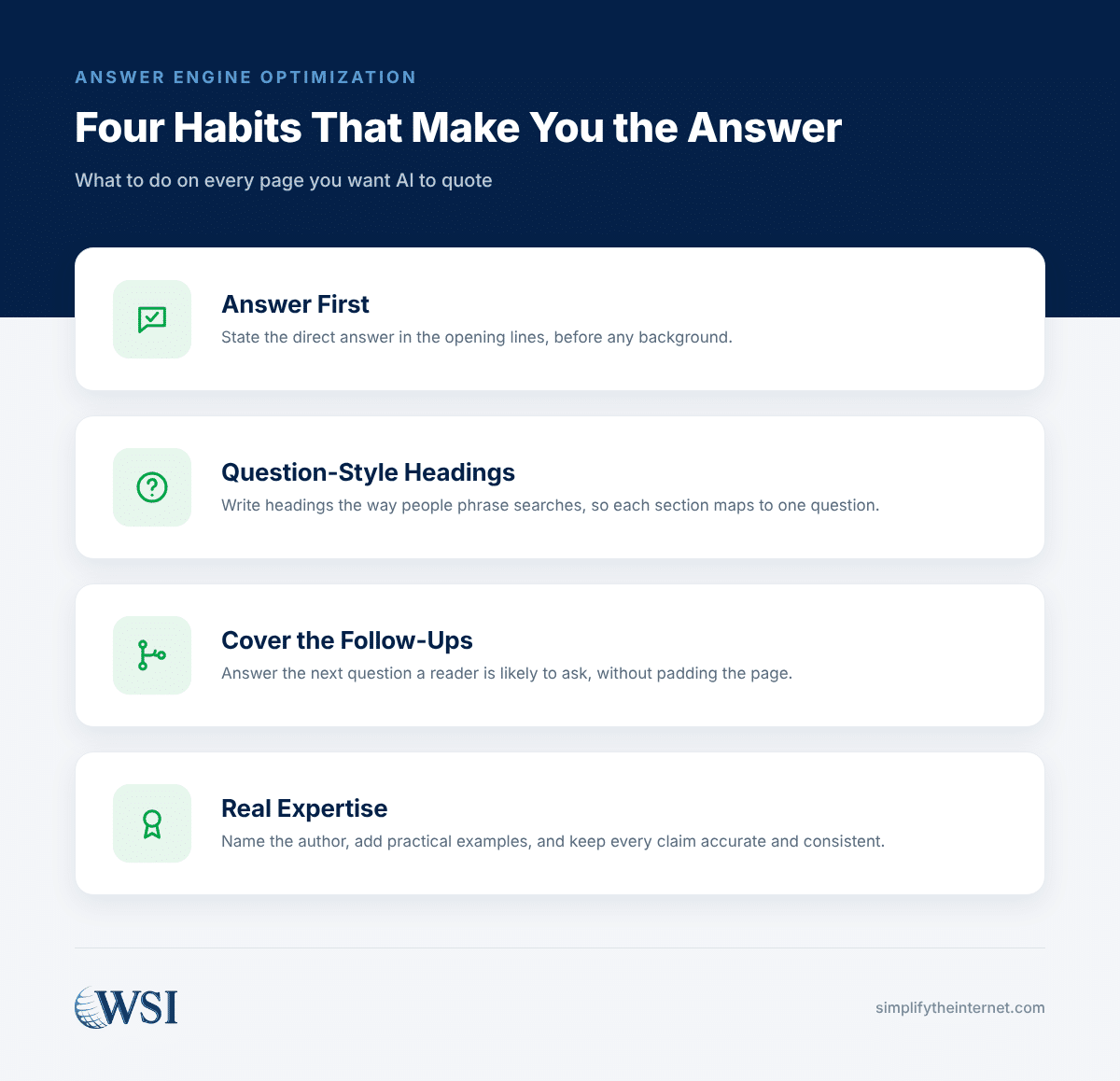
Start by writing explicit answers. Do not imply meaning or bury key points. If a reader asks a question, the answer should be immediately clear within the content.
44.2% of all LLM citations come from the first 30% of a piece of content.
AI systems extract and cite intro-level answers. Content buried mid-article is far less likely to be surfaced. Source: Growth Memo, February 2026
Structure content for AI readability. Use headings that reflect real search questions. Break information into logical sections, lists, and steps.
Cover topics completely, but avoid padding. Depth comes from completeness, not length. Address the natural follow-up questions a reader would have.
Demonstrate experience and expertise. Include practical insights, examples, and explanations that show the content was written by someone who does the work. Generic advice is easy for AI systems to ignore.
Reinforce E-E-A-T by clearly identifying the author, maintaining factual accuracy, and aligning claims consistently across related pages.
Keep answers current. Review your key pages on a schedule, because an outdated answer may be passed over for a fresher one.
A useful test is to ask: could an AI safely quote this section as a definitive answer? If the answer is yes, the content is likely AEO-ready.
Schedule Your Free Website Audit
Answer Engine Optimization Tools and Platforms
AEO tools generally fall into three categories:
- Content tools that help structure and analyze answer-focused content
- Monitoring tools that track brand mentions and AI visibility
- Analytics tools that measure assisted influence rather than only traffic
These tools can help identify gaps, monitor performance, and validate progress. However, tools alone do not create authority. Without a clear strategy, experience-driven content, and consistent execution, tooling provides limited value.
When evaluating AEO platforms, look for transparency in data sources, the ability to track AI citations over time, and integration with your broader SEO and analytics stack. This category is also changing quickly, so treat any tool as one input rather than the final word.
Not sure how your site holds up for AI search?
Start with a free website audit. We’ll identify structural gaps and show you what’s preventing your content from being cited in AI Overviews.
Answer Engine Optimization Services: When to Use an Agency
Many organizations reach a point where AEO requires more than internal effort.
AEO services typically include content audits, answer-focused content development, topical authority mapping, AI visibility monitoring, and integration with existing SEO strategies.
Outsourced AEO is particularly valuable for mid-market and enterprise organizations with complex offerings, regulated industries, or limited internal content expertise.
The difference between DIY and agency-led AEO often comes down to experience. Agencies that actively work with AI-driven search understand how answers are extracted, where attribution fails, and how to structure content to earn trust at scale.
AEO should never exist in isolation. The strongest results come when it is integrated with technical SEO, content strategy, conversion optimization, and analytics.
Is your business showing up in AI-generated answers?
Find out where you stand. Book a free 30-minute consultation and get a clear picture of your AI search visibility, and what it will take to own it.
FAQs
What Is Answer Engine Optimization?
Answer engine optimization is the practice of structuring content, especially clear question-and-answer formats, so AI platforms and voice assistants can select it as a direct answer.
How Is AEO Different from Traditional SEO?
Traditional SEO aims for a high-ranking position in a results list. AEO aims to be the specific source an AI system quotes or paraphrases when answering a question directly, which often depends on concise, well-structured Q&A content.
Is Answer Engine Optimization Replacing SEO?
No. AEO complements SEO. SEO builds discoverability, while AEO helps your content get selected and cited by AI systems.
How Do You Optimize Content for AI Answer Engines?
By writing explicit answers, using clear structure, aligning headings with real questions, and demonstrating expertise and trustworthiness throughout the content.
What Types of Businesses Benefit Most from AEO?
Businesses with complex products, long sales cycles, or high-consideration decisions benefit most, particularly in B2B, professional services, and regulated industries.
Do I Need Special Tools for Answer Engine Optimization?
Tools can help monitor and support AEO efforts, but strategy, experience, and content quality matter far more than software alone.
How Does AEO Relate to Generative Engine Optimization?
AEO and generative engine optimization (GEO) overlap heavily, since both aim to get content selected by AI systems. AEO leans toward direct answers and voice assistants, while GEO is the wider practice of being understood and cited across generative platforms. If you are not sure which your business needs first, book a free consultation and we can look at your current AI search visibility together.

Don't stop the learning now!
Here are some other blog posts you may be interested in.
VIEW ALL BLOG POSTS-
Generative Engine Optimization (GEO): The Next Evolution of SEO
Search no longer ends with a list of blue links. When someone asks Google, ChatGPT, or Perplexity a question, they increasingly get …
READ MORE -
Customer Journey Mapping: How to Understand, Design, and Optimize Every Stage of the Buyer Journey
Customer journey mapping is the process of visualizing how a customer interacts …
READ MORE -
Answer Engine Optimization (AEO): Getting Cited in AI-Generated Answers
Ask a question out loud to a phone, or type it into ChatGPT, and the reply often arrives as a single paragraph with no list of websites …
READ MORE