


How a Digital Marketing Agency Helps Generate Qualified Leads
Last Updated: 2 months ago

SUMMARY: A digital marketing agency generates qualified leads by combining SEO, paid advertising, and conversion-optimized landing pages into one connected system, so traffic is matched to buyer intent and guided toward a clear next step. This article breaks down how that system works and what separates a qualified lead from ordinary website traffic.

Most businesses do not have a traffic problem. They have a qualification problem: visitors arrive, look around, and leave without ever indicating whether they were a real prospect in the first place. A digital marketing agency’s job is to close that gap with a lead generation strategy that treats SEO, paid advertising, and conversion-focused web pages as one connected system rather than three separate tactics. Here is how that system works, and how to tell a qualified lead from noise.
The Difference Between Traffic and Qualified Leads
Traffic is simply the number of people who land on a website, regardless of who they are or why they showed up. It is the easiest marketing metric to point to, and one of the least useful on its own, because a spike in visitors does not tell you whether any of them could realistically become a customer.
A qualified lead is different. It is a visitor who has both shown genuine interest and fits the profile of who the business wants to serve, typically demonstrated through an action such as filling out a form, calling the number on the page, or requesting a quote. Fit matters as much as the action. A homeowner submitting a quote request to a plumbing company is a qualified lead. A student researching a class project who fills out that same form technically converts, but is not.
Signs a website visitor has become a qualified lead:
- Completed a form requesting a quote, consultation, or callback
- Called or messaged the business directly from the website
- Matches the business’s target audience by location, budget, or need
- Took a specific next step, such as booking a demo or requesting a follow-up
This distinction is why “more traffic” is rarely the right goal on its own. A digital marketing agency’s work is to increase the number of visitors who take one of these actions, not simply the number who show up in the first place.
How SEO and Paid Advertising Feed a Lead Generation System
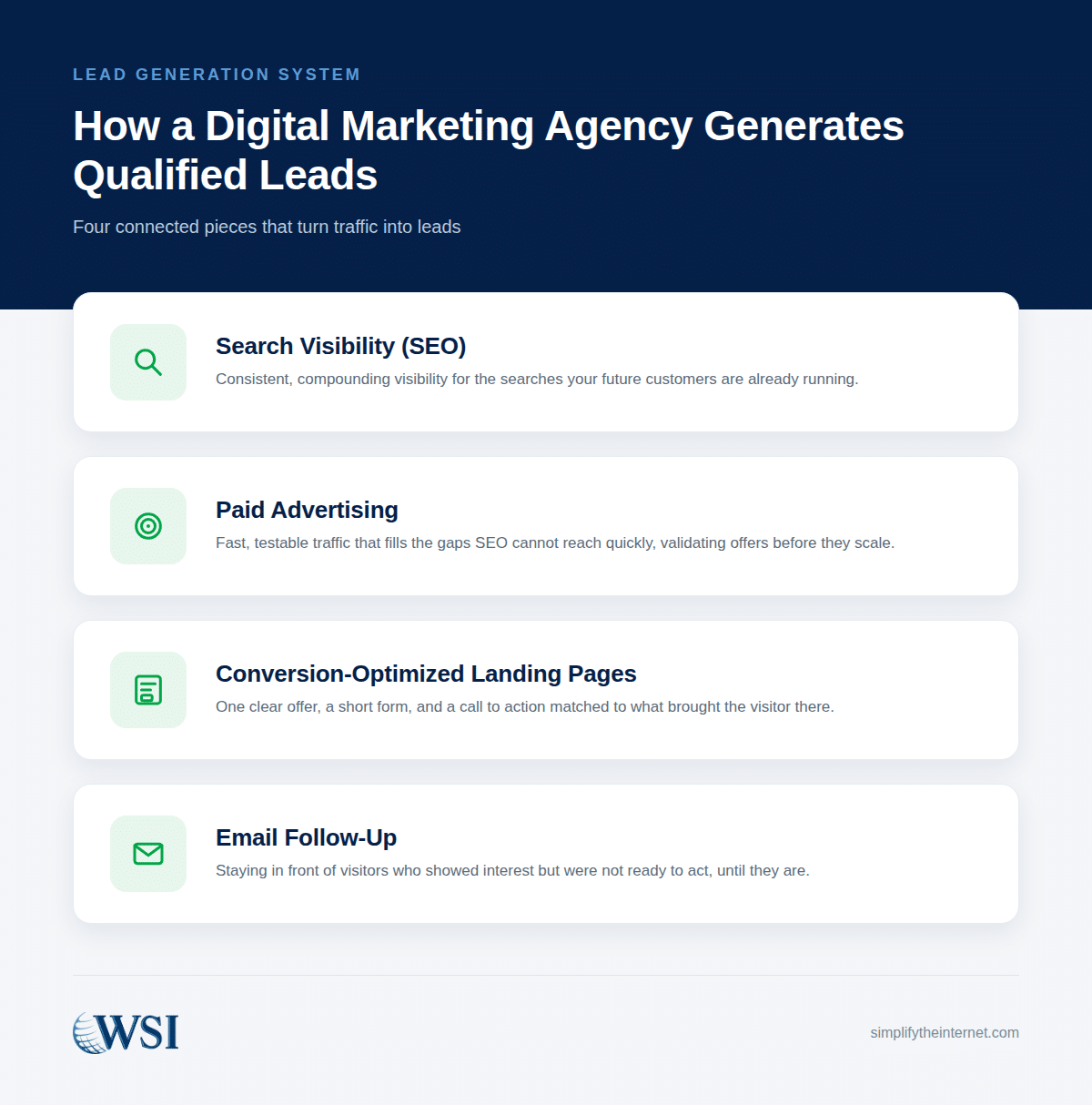
SEO and paid advertising often get compared as though a business has to pick one, but they solve different problems inside the same lead generation system. SEO and search services is how a business earns consistent, compounding visibility for the searches its future customers are already running, whether that is a specific service, a location-based search, or a comparison between options. It takes longer to build, but the traffic it earns tends to arrive already partway through a buying decision.
Paid advertising fills the gaps SEO cannot reach quickly: a new service that has not ranked yet, a seasonal push, or a competitive term that would take months to earn organically. Paid campaigns can be switched on, tested, and adjusted within days, which makes them useful for validating which offers and messages convert before a business invests further in organic content built around the same ideas.
The connection between the two is where a lead generation system gets built. Keyword and audience data from paid campaigns tells an SEO strategy which topics and offers are worth pursuing organically, and the content built for SEO gives paid campaigns somewhere stronger to send traffic than a generic homepage. Consistent tracking across both channels also makes it possible to see which keywords, ads, and pages are producing leads instead of just clicks, so budget shifts toward what works rather than what simply generates volume. Run separately, SEO and paid advertising each produce some amount of traffic. Run together, they produce visitors who arrive already narrowed toward a specific need.
The Role of Landing Pages and Conversion Optimization
SEO and paid advertising can send the right person to a website, but what happens on that page decides whether they become a lead at all. That is the job of conversion rate optimization: testing and refining the layout, message, and call to action on a page until more of the right visitors take the next step, rather than assuming the first version a business publishes is the best one it will ever have.
A landing page built for lead generation looks different from a typical website page. It usually has one clear offer, a short form asking only for what is needed to follow up, and a call to action that matches what brought the visitor there in the first place, whether that was a search result, an ad, or a referral. Businesses redesigning a site with this in mind, including web design in Aurora clients working with a team that understands local search behaviour, tend to see the biggest gains by simplifying pages rather than adding more to them.
Not every visitor converts on the first visit, and a strong system accounts for that. Staying in front of visitors who showed interest but were not ready to act, through email marketing and other relevant follow-up, is often what separates a business generating a handful of leads from one that consistently converts the traffic it already has.
Frequently Asked Questions
How Can A Digital Marketing Agency Help A Business Generate More Qualified Leads?
An agency combines SEO, paid advertising, and conversion-focused landing pages into one system, so traffic is matched to intent and guided toward a clear next step, rather than left to convert on its own. This coordinated approach tends to produce more qualified leads than running each channel independently.
What Results Can A Business Expect From Lead Generation Services?
Results depend on your starting point, industry, and the channels involved. Most clients begin seeing measurable lead volume increases within 60 to 90 days of launching a structured program. Quality of leads should be measured alongside quantity, since a smaller number of well-matched leads is usually worth more than a larger number of unqualified ones.
What Is The Difference Between Traffic And Qualified Leads?
Traffic is simply visits to a website. A qualified lead is a visitor who has shown genuine interest and fits the business's target audience, typically identified through forms, calls, or other conversion actions.
Seeing where your traffic is falling short of becoming leads usually takes a look at your own numbers, not general advice. You can book a free consultation and walk through what a connected lead generation system would look like for your business.

Don't stop the learning now!
Here are some other blog posts you may be interested in.
VIEW ALL BLOG POSTS-
How a Digital Marketing Agency Helps Generate Qualified Leads
Most businesses do not have a traffic problem. They have a qualification problem: visitors arrive, look around, and leave without ever indicating whether …
READ MORE -
Digital Marketing Agencies for Growing Ontario Businesses
Most digital marketing advice, and a lot of agency positioning, is written with downtown Toronto in mind. That is a problem for the growing businesses in Hamilton, Richmond Hill, Uxbridge, and …
READ MORE -
Integrated Digital Marketing Services: SEO, Paid Advertising, Web, and Content Under One Strategy
Most businesses do not plan to end up with a fragmented marketing setup. It happens gradually, one specialist….
READ MORE