


Measurable Growth vs. Vanity Metrics: What a Results-Focused Agency Tracks
Last Updated: 2 hours ago

SUMMARY:Vanity metrics in digital marketing, such as impressions and followers, look impressive but do not show business impact. Measurable growth is tracked through qualified leads, conversion rate, cost per lead, and return on ad spend. This article explains the difference and what to look for in an agency's reporting.

A report full of impressions, followers, and page views can feel like proof that marketing is working. Then the quarter ends, the phone has not rung any more often, and nobody can explain why the numbers went up while the business stayed the same. That gap is why vanity metrics in digital marketing get so much attention from owners who have been burned before. This article explains how to tell a vanity metric from a measurable one, which numbers a results-focused marketing agency should be tracking for you, and what good reporting looks like when it is tied to revenue.
Why Vanity Metrics Can Hide Poor Performance
A vanity metric is any number that looks good in a report but cannot be traced to a lead or a sale. Impressions, follower counts, page views, and likes are the usual examples. They are not useless. Impressions show how often an ad was displayed, and traffic shows whether a page is getting found. The trouble starts when they are the only numbers on the page, because each one stops a step short of the question a business owner cares about: did this bring in customers?
Picture a physiotherapy clinic whose agency reports that website traffic doubled over three months. It sounds like a win until the clinic checks its booking line and finds appointments are flat. The extra visitors might be students reading about stretching routines, or people searching from well outside the service area, or readers of one article that took off for the wrong reasons. The traffic is real, but it is not buying anything. A report that ends at the traffic number lets a month like that pass as a success.
A good habit is to ask the same follow-up question of every number in a report: so what? If traffic is up, so what happened to enquiries? If impressions are up, so what happened to cost per lead? A number that cannot survive that question is probably decoration.
Vanity metrics also hide trouble in a quieter way. When ad spend goes up, impressions usually climb with it, so a bigger number can reflect nothing more than a bigger budget. Followers can be gained through giveaways that attract people with no interest in buying. In both cases the chart rises while the cost of winning a customer slowly gets worse.
A useful first step is to see where your site stands today. A free SEO audit shows how the pages that attract visitors line up with the pages meant to turn them into leads, which makes it easier to spot traffic that is arriving without going anywhere.
The Metrics That Actually Reflect Business Growth
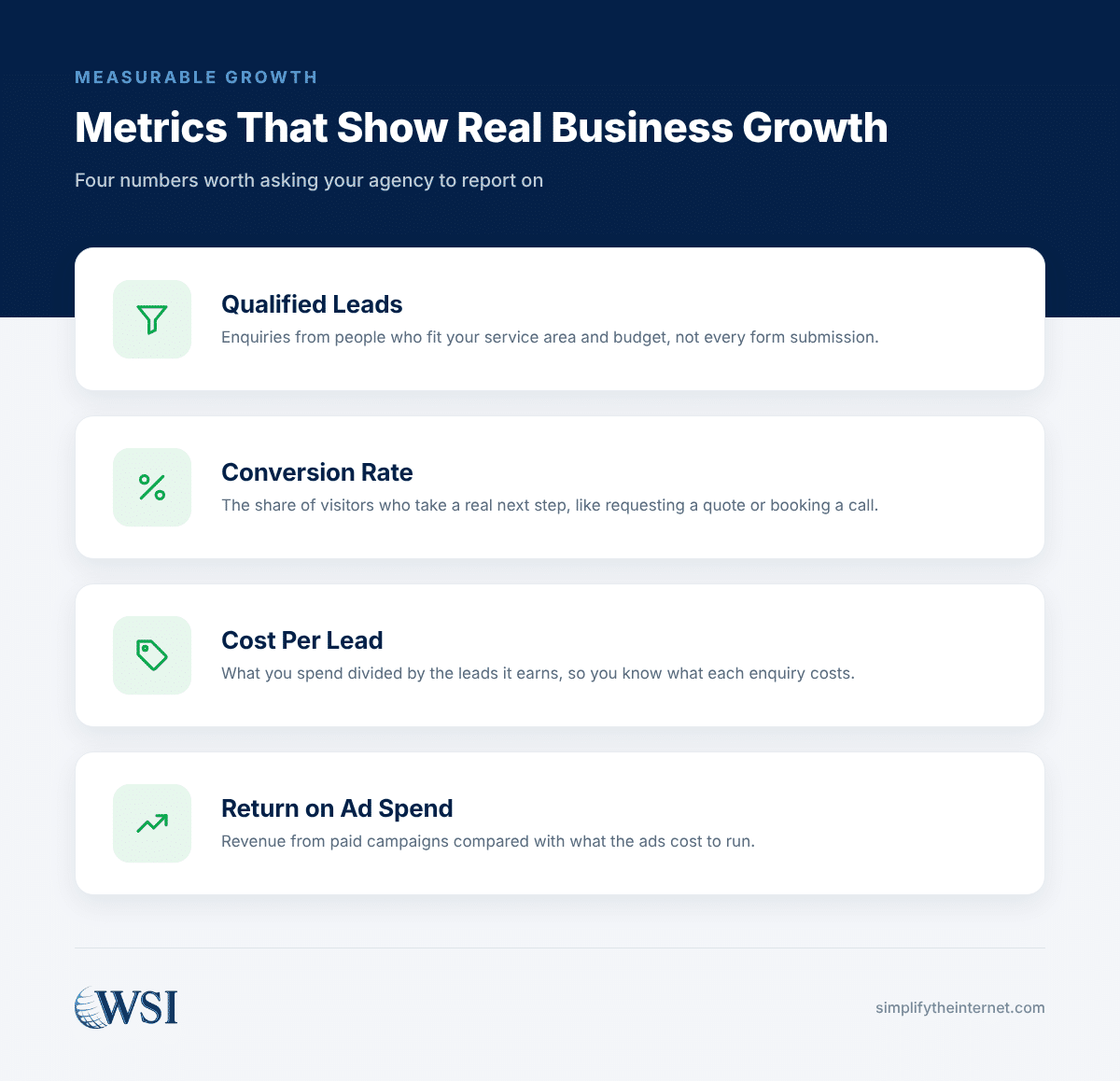
Measurable growth comes from numbers that sit closer to revenue. Four of them do most of the work, and together they show whether marketing spend is paying for itself:
- Qualified leads: enquiries from people who fit the business’s service area and budget, such as a booked consultation or a quote request, rather than every form submission
- Conversion rate: the share of visitors who take a meaningful next step, so 40 quote requests from 1,000 visitors is a 4% conversion rate
- Cost per lead: total marketing spend divided by the leads it produced, so $2,000 spent to earn 10 qualified leads is $200 per lead
- Return on ad spend: revenue from paid campaigns divided by what was spent on them, so $8,000 in sales from $2,000 in ads returns four dollars for every dollar spent
These four also keep each other honest. A low cost per lead means little if the leads are poor fits, and a strong conversion rate on a handful of visitors proves less than it seems. Reading them side by side gives a fuller picture than any single figure can.
Traffic and visibility numbers still have a place. They work best as early signals that explain why leads moved up or down. A rise in rankings for a service search is encouraging, and it becomes proof once leads from that search start showing up in the numbers above.
This is also why a digital marketing agency built around measurable growth treats search and conversion as one system. Strong SEO services are judged by the leads that organic traffic produces, not by ranking screenshots on their own. Local competition adds another layer. A dental clinic using SEO services in Uxbridge, for example, should be measured by how many nearby patients book after finding it, since a top ranking in a city two hours away adds little to the appointment calendar.
How Reporting Should Connect Marketing Activity to Revenue
Good reporting follows a lead from first click to closed sale instead of listing activity in separate piles. It helps to picture the chain as four links:
- The activity: the ad, search result, or email that brought someone in
- The action: the call, form, or booking that person made
- The lead status: whether the enquiry was qualified, and whether it became a sale
- The revenue: what that sale was worth compared with what it cost to win
A report that jumps from the first link to the last without the middle two is guessing at the connection.
This takes cooperation from the business, too. Marketing ROI tracking is only as accurate as the information flowing back from the sales side. Call tracking, a source field on every enquiry form, and a habit of noting where each new customer came from let an agency connect spend to revenue. Without that feedback, even a careful agency is working from half the picture.
Reporting built this way also shows where money is leaking. If a landing page earns plenty of visits but few enquiries, the fix is rarely more traffic. It is improving the page itself, which is the work of conversion rate optimization: testing headlines, forms, and calls to action until a bigger share of visitors take the next step. Each test is judged by the same measures, so the improvement is easy to see.
An agency committed to measurable growth will also report on a regular schedule, explain what changed, and say what happens next, including when something did not work. Honest reports sometimes carry bad news. That is a good sign, because a team tracking real outcomes has nothing to gain from hiding them.
Frequently Asked Questions
Which Digital Marketing Agencies Focus on Measurable Business Growth Rather Than Vanity Metrics?
Agencies that report on qualified leads, conversion rate, and return on ad spend, rather than only impressions or followers, are generally more focused on measurable business growth. A quick way to check is to ask for a sample report before signing. If the first page is mostly traffic and social numbers, the agency is leading with what is easy to show instead of what you need to know.
What Metrics Should a Business Ask an Agency to Report On?
Key indicators include qualified leads generated, conversion rate, cost per lead, and return on ad spend, alongside traffic and visibility metrics. Regular reporting on these should show clearly what is and is not performing. It also helps to ask for the numbers broken out by channel, so you can see whether search, paid ads, or email is producing the leads.
What Are Vanity Metrics in Digital Marketing?
Vanity metrics are numbers that look impressive, such as impressions, followers, or page views, but do not directly show whether marketing is generating leads or revenue for the business. They become useful only when paired with a measure of what those visitors did next. If your last report leaned heavily on them, bring it along when you book a free consultation and walk through the same months measured by leads and cost per lead.

Don't stop the learning now!
Here are some other blog posts you may be interested in.
VIEW ALL BLOG POSTS-
How a Digital Marketing Agency Helps Generate Qualified Leads
Most businesses do not have a traffic problem. They have a qualification problem: visitors arrive, look around, and leave without ever indicating whether …
READ MORE -
Digital Marketing Agencies for Growing Ontario Businesses
Most digital marketing advice, and a lot of agency positioning, is written with downtown Toronto in mind. That is a problem for the growing businesses in Hamilton, Richmond Hill, Uxbridge, and …
READ MORE -
Integrated Digital Marketing Services: SEO, Paid Advertising, Web, and Content Under One Strategy
Most businesses do not plan to end up with a fragmented marketing setup. It happens gradually, one specialist….
READ MORE