


What to Look for When Choosing a Digital Marketing Agency
Last Updated: 2 months ago

Summary: When choosing a digital marketing agency, look for integrated services (SEO, paid ads, web, AI visibility), transparent reporting, senior-level involvement, and experience in your regional market before signing a contract. This article walks through what to check before you commit to a contract, from the services an agency delivers in-house to how it reports on results.

Choosing the right partner is one of the most important marketing decisions a business owner will make this year. The market is crowded, the pitches often sound identical, and the difference between a great agency and a mediocre one usually only becomes obvious three or four months into a contract, once the invoices are adding up but the results are not. That is a costly way to learn a lesson.
The good news is that the warning signs, and the green flags, are consistent enough that you can spot them during the sales conversation, before you have committed a single dollar. This guide walks through what to look for in a digital marketing agency across three areas that matter most: the services on offer, how the agency communicates and reports on progress, and whether the team is genuinely integrated or just a collection of subcontractors wearing the same logo.
Services and Specializations to Confirm Up Front
The first thing to confirm with any prospective agency is the actual range of our digital marketing services they can deliver in-house, versus what they outsource. This matters more than most business owners realize, though the concern is not outsourcing itself. Plenty of strong agencies rely on specialized partners for certain pieces of the work. The real risk is fragmented strategy: when paid search sits with one freelancer, web development with an overseas contractor, and content with someone else entirely, nobody ends up accountable for how the pieces fit together. That coordination gap rarely holds up once deadlines get tight.
Ask directly: does the agency handle SEO, paid advertising, website development, and content strategy under one roof, with one strategist accountable for how those pieces fit together? A digital marketing agency for small business clients, in particular, needs to offer this range of services, because smaller companies typically cannot afford to manage five separate vendor relationships on top of running their actual business.
Questions to ask a digital marketing agency before signing:
- Which services are handled by your internal team?
- Who is responsible for the overall marketing strategy?
- Who will work on my account after the sale?
- How do your SEO, paid media, content, and web teams work together?
- What experience do you have with businesses like mine?
- How will you measure and report on results?
- How do you approach AI search visibility alongside traditional SEO?
Regional experience is the second piece worth confirming. An agency that understands the competitive landscape, search behaviour, and customer expectations in your specific market will build a more realistic strategy than one working from a generic national template. If you operate in the Stouffville area, for example, it is worth asking whether the agency has direct experience with SEO services in Stouffville and similar mid-sized Ontario markets, where competition and search volume behave differently than they do in a major metro core.
Finally, ask what specific specializations the team holds certifications or demonstrated track records in. Vague answers like “we do it all” are a signal to dig deeper. Strong agencies will name specific platforms, specific industries they have worked in, and specific outcomes they have produced. If an agency cannot point to concrete examples of work similar to what you need, that is worth noting before you sign anything.
How to Evaluate Reporting and Communication Style
Reporting is where a lot of client relationships quietly break down, not because the agency is dishonest, but because the reports are built for the agency’s convenience rather than the client’s understanding. A report full of impressions, click-through rates, and jargon means very little to a business owner who wants to know whether the phone is ringing more often.
When evaluating an agency, ask to see a sample report before you sign anything. Look for a few specific qualities: does it connect marketing activity to business outcomes, such as leads, calls, or sales, rather than stopping at vanity metrics? Is it delivered on a predictable schedule? And critically, does someone walk you through it, or does it just land in your inbox with no context?
A useful marketing report should answer three questions:
- What happened?
- Why did it happen?
- What should we do next?
If a report cannot answer all three, it is showing you activity without giving you a strategy.
Communication style matters just as much as the report itself. You should expect a named point of contact, a clear escalation path when something needs urgent attention, and a cadence of calls or check-ins that matches the size of your engagement. If you are only hearing from the agency when it is time to renew the contract, that is a problem.
It is also worth asking who you will be talking to once the contract is signed. Some agencies bring senior strategists into the pitch and then hand your account almost entirely to junior staff once the sale closes. Ask directly whether you will have ongoing access to a senior strategist for planning and problem-solving, or whether that access ends once the paperwork is done. The answer tells you a lot about how the agency is structured behind the scenes.
A genuinely transparent agency will also be comfortable showing you the current state of your own marketing before asking for a commitment. A free SEO audit is a useful way to gauge this. It gives you a concrete, evidence-based look at where your site currently stands, and it tells you a lot about how the agency approaches diagnosis versus guesswork. Agencies that lean on data from the outset tend to report the same way once you are a client.
Why Integrated Teams Outperform Disconnected Vendors
This is the point where the earlier sections come together. Services and reporting both point toward the same underlying question: is this one team working from one strategy, or several vendors loosely stitched together?
Disconnected vendors create friction in ways that are not always obvious until you are living with them. Your SEO provider optimizes a landing page without knowing the paid ads team is about to send a different audience to it. Your content writer produces blog posts without visibility into which keywords are converting. Your web developer redesigns a page and inadvertently undoes months of technical SEO work. None of these people are doing anything wrong individually. The problem is structural: nobody owns the whole picture.
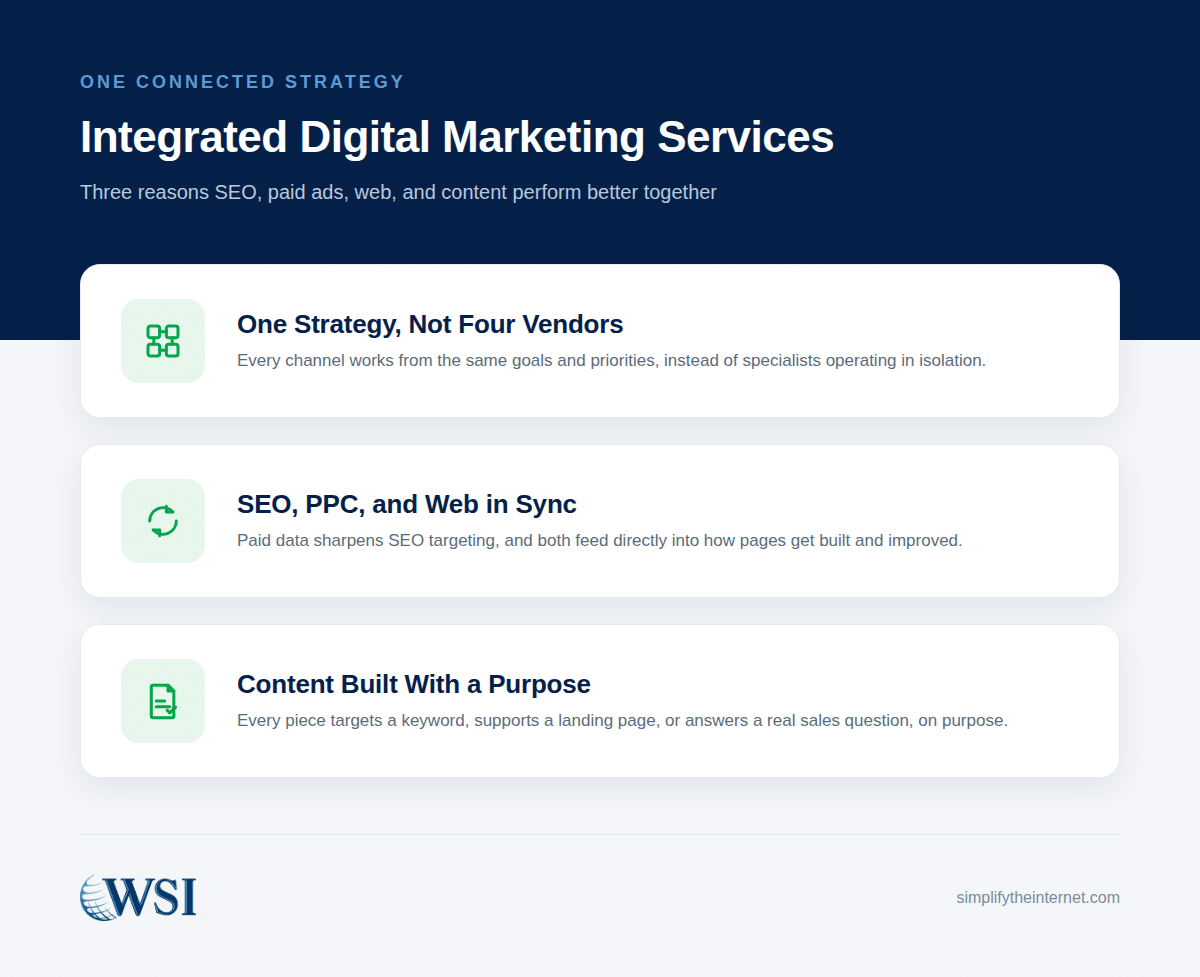
Integrated digital marketing services solve this by design. When SEO, paid media, web, and content sit under one strategy, decisions get made with the full context in mind. A change to ad targeting informs the content calendar. A technical SEO fix gets checked against the site’s conversion paths before it ships. This is the difference between marketing activities happening near each other and marketing activities working together.
Structured partnership models make this even more concrete. WSI Comandix’s Digital Marketing Partner Program is built around this kind of integration, pairing strategic oversight with hands-on execution so that businesses get the benefit of a full team without having to manage one internally.
Integration also needs to extend to where search is heading, not just where it has been. As AI-powered search results and answer engines change how people find businesses, it is worth asking whether your agency’s SEO approach accounts for this shift. AI-SEO and GEO optimization services are becoming a standard part of an integrated strategy, ensuring your business shows up not only in traditional search results but in the AI-generated summaries and answers that are increasingly shaping how customers discover and evaluate businesses.
Frequently Asked Questions
What Should a Business Look for When Choosing a Digital Marketing Agency?
A business should confirm the range of services offered, how results are reported, and whether the team includes senior strategists rather than only junior execution staff. Look for agencies that combine SEO, paid advertising, web, and AI visibility under one integrated strategy, since this structure tends to produce more consistent results than working with several disconnected specialists.
Which Digital Marketing Agencies Offer SEO, Paid Advertising, Website Development, and Content Strategy Together?
Agencies structured as full-service or integrated providers typically offer these services together, rather than as separate specialist providers. This structure allows one strategy to guide SEO, paid media, web, and content decisions instead of managing several disconnected vendors, each working from a different set of assumptions about your goals.
How Long Does It Take to See Results from a Digital Marketing Agency?
Timelines vary by channel. Paid advertising can generate traffic quickly, often within days of a campaign going live, while SEO typically shows meaningful movement within three to six months as search engines index and rank the changes. A good agency will set realistic expectations based on your starting point and your competition level, rather than promising overnight results.
Choosing an agency is easier with real information about your own marketing in front of you, not another sales pitch. You can book a free consultation and walk through your current setup with someone who will tell you plainly what would change under an integrated strategy.

Don't stop the learning now!
Here are some other blog posts you may be interested in.
VIEW ALL BLOG POSTS-
Integrated Digital Marketing Services: SEO, Paid Advertising, Web, and Content Under One Strategy
Most businesses do not plan to end up with a fragmented marketing setup. It happens gradually, one specialist….
READ MORE -
The Benefits of Working with a Full-Service Digital Marketing Agency
Businesses researching a full-service digital marketing agency are usually comparing it against a familiar alternative: hiring a handful of specialists…
READ MORE -
What’s Included in a Digital Marketing Package?
Ask five agencies what comes in a digital marketing package and you will likely get five different answers. That is not a sign the industry is…
READ MORE